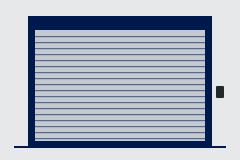
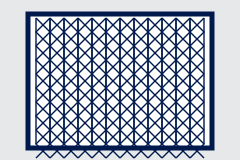
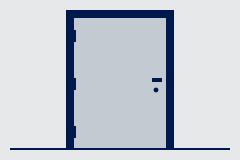
 Shutter and
What do I need before I start?
You need a steel tape, a phone for photos and a second person if the opening is wide. Measure in millimetres and write each figure down as you go. The price calculator takes metres, so 2400 mm goes in as 2.4.
| Record | Note |
|---|---|
| Width | Top, middle and bottom |
| Height | Left and right |
| Above the opening | Clear height and depth to the next obstruction |
| Each side | Clear width and what the surface is |
| Floor | Surface, slope and any step |
| Power | Nearest supply, for an electric shutter |
| Use | Who opens it and how often |
Decide first whether the shutter would go outside or inside the glass, because you measure different things. If you are not sure, measure both. The position comparison helps with that choice.
Your figures give you a working price. They do not need to be perfect, because for a new installation the site survey is free and sets the final sizes.
How do I measure the width?
Measure from one side of the opening to the other at the top, middle and bottom. Old shopfronts are rarely square, and those three figures will often differ.
Use the smallest figure for a price. For a shutter that fits between the sides of the opening, that is the width that has to clear. For a shutter fixed to the face of the building, also measure the width of flat, sound wall or frame on either side, because the guides need somewhere to fix.
Include anything that sticks out into the opening, such as a mullion, a door frame, a pipe or a downpipe bracket.
How do I measure the height?
Measure from the finished floor or pavement up to the underside of the head, at both sides. Take the smaller figure.
Pavements slope, so a shop front that looks level may be well out from one side to the other. Note if the floor falls towards the road, because a bottom rail has to close against the ground along its whole length.
If there is a step or a raised threshold, measure to both levels and note which one the shutter should land on.
For a counter shutter, measure from the worktop up to the underside of whatever is above it, and note any till, screen or shelf on the line of the curtain.
How much room do I need above the opening?
Record what you have and the survey will confirm what you need, because the box size depends on the height of the shutter and the curtain. Do not rely on a general figure for this one.
Measure from the top of the opening up to the next obstruction. Outside, that is usually the underside of the fascia, a sign, a canopy or a first-floor window. Inside, it is the ceiling, a suspended grid or a bulkhead.
Measure the depth too. Outside, note how far the fascia sits proud of the shopfront, because a box behind the fascia needs depth as well as height. Inside, measure from the back of the glass to the first thing that gets in the way.
How much room do I need at the sides?
Record the clear space on each side of the opening, because the guides have to sit there and fix into something solid. Note what that surface is: brick, stone, steel, timber, render or cladding.
Watch out for downpipes, alarm boxes, lights, door closers and a neighbour's shopfront. On a parade, a shared pier can be narrow and the next shop's guide may already be on it.
For a retractable grille, you also need room for the folded stack. Note how far the grille would reach into the opening when pushed to one side, and what that would block.
What should I check at the floor?
Check what the bottom rail will land on and whether a lock can fix into it. Floor locks need a sound surface. Broken slabs, loose tiles and thin thresholds are all things to flag.
Note any door that opens outwards, any step, any drain channel and any A-board or bollard fixed near the line of the shutter. Look at the width of the pavement too, if the box or guides would project.
If the floor is tiled or has been relaid, say so. A floor lock may need a different fixing, and the survey will want to know what is under the surface.
What should I photograph?
Take a straight-on shot of the whole frontage and one close shot of each corner of the opening. Those photos tell us more than a page of notes.
- The full front, from across the road if you can
- The top of the opening, showing the fascia or ceiling
- Each side, showing what the guides would fix to
- The floor line along the whole width
- Any existing shutter, its box and its label
- The nearest power socket or spur, for an electric shutter
Put your tape in one or two shots so that the scale is clear. You can send them through the contact page with your sizes.
What counts as the starting size?
The starting size is 2.4 m by 2.4 m for roller shutters and doors for units, 1.2 m wide by 2.4 m high for a security grille, 2 m wide by 1.2 m high for a manual aluminium counter shutter, and a single leaf up to 1 m by 2.1 m for a steel security door. The starting price is the lowest figure, for an opening up to the starting size with the basic specification. Most openings cost more.
Multiply your width by your height in metres to see where you stand. A shutter opening of 2.4 m by 2.4 m is 5.76 square metres. The price calculator will say if your size is more than it can price. If it does, call us on 0800 088 6248.
Several small openings are not one big one. Each shutter is priced separately, so measure each and list them.
A corner shop with glass on two sides counts as two openings. A front with a recessed door between two windows may count as three if each part closes separately. Sketch the frontage from above and mark what you want covered, because one shutter across a recess is a different job from three small ones.
What will the survey check that I cannot?
The survey checks what is behind the surface. It looks at whether the wall or frame will take the fixings, whether the box will fit, and how the shutter will be used, which decides the safety features a powered shutter needs.
It also confirms the power supply, the access and anything that clashes. For a new installation the survey is free and carries no obligation, and you get an itemised written quotation afterwards. Repairs, servicing and board-up are paid call-outs.
Common questions
Should I measure the opening or the existing shutter?
Measure both if a shutter is already there, and tell us which is which. The old shutter may not be the right size for a new one.
Can I order from my own measurements?
No. Your measurements give a guide price. For a new installation, the survey sets the final sizes before anything is ordered.
Do I measure a steel door the same way?
Measure the frame opening in the same way, at the top, middle and bottom, and note which way the door opens and which side it hinges. The survey confirms it.
What if the opening is not square?
Tell us, and send photos. Old openings often are not, and the guides and bottom rail have to allow for it. That is one of the things the survey is for.