 Shutter and
Counter shutters
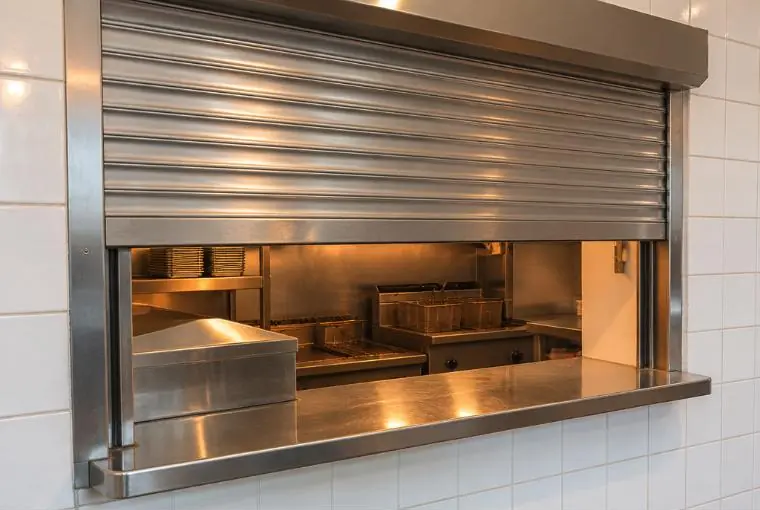
A counter shutter is a compact roller shutter that closes a serving hatch or counter, landing on the worktop instead of the floor. It starts from £954 inc VAT (£795 plus VAT) as a manual aluminium shutter for an opening up to 2 m wide by 1.2 m high.
The guide range covers most shop openings. Larger openings cost more, and the calculator or your quotation gives the figure.
What is a counter shutter and where is it used?
A counter shutter is a compact roller shutter that closes a hatch or counter and lands on the worktop, not the floor. You see them at takeaway serving hatches, kitchen passes, bars, kiosks, pharmacy counters and trade counters.
It is built small because customers see it up close, with a finer lath, a slim box and neat guides. It closes the counter out of hours or during a break, and it keeps hands and eyes off what sits behind it. It secures the counter only, so the front of the premises still needs its own roller shutter.
How much does a counter shutter cost?
A counter shutter costs from £954 inc VAT (£795 plus VAT) as a manual aluminium shutter for an opening up to 2 m wide by 1.2 m high. That is the lowest figure, and most openings cost more. Stainless steel, electric operation or a larger opening each move the figure. The guide range runs £954 to £2,034 inc VAT, and your price comes on an itemised quotation after a free site survey.
| What changes | Why it moves the price |
|---|---|
| Material | Stainless steel costs more than aluminium. |
| Operation | Electric adds a motor, a control, trapping protection and a power supply. |
| Box position | A box hidden in a ceiling void takes more work than one on the wall face. |
| Wall finish | Tiles and steel wall cladding take more care to fix through than plain block. |
| Worktop | An uneven or overhanging counter may need a landing strip or a change to the edge. |
| Old shutter | Removing an existing one is listed separately. |
The prices page has our full guide list.
What should you measure for a counter shutter?
Measure the clear width between the walls, the height from the worktop to whatever sits above, and the depth of the worktop. Take each one at both ends, because hatches are rarely square. Our guide on how to measure an opening shows where to put the tape.
Then look for what is in the way. Extract ducts, pipes and ceiling lights all compete with the box. Card readers, tills and food screens sit right on the line where the curtain lands, and a worktop overhang decides where the guides stop. Move them or design round them before the order goes in. Photograph the hatch from both sides and send the pictures with your sizes, as they show what a tape cannot.
Which material suits a kitchen or takeaway counter?
Stainless steel suits a working kitchen, where you want a surface you can wipe down after a shift. Aluminium is lighter and costs less, which suits a bar, reception or pharmacy counter, and a powder-coated colour can match the joinery around it.
Whichever you pick, grease in the guides is what makes a counter shutter stick. Keep the guides where someone can reach them with a cloth, and avoid setting them tight against a fryer or hot plate. Ask for the cleaning notes with the quotation, and put the shutter on your kitchen cleaning rota.
Should a counter shutter be manual or electric?
Manual suits most small hatches, because the curtain is short and the person closing it is standing right there. Electric earns its place on a long counter or one that is awkward to reach across.
A powered counter shutter comes down at hand height, right where people lean, so trapping deserves more thought here than on a shop front. It needs suitable features to prevent trapping, and the electric roller shutters page explains the options. We assess it at survey, with your staff and customers in mind.
How long does a counter shutter take to fit?
Your quotation confirms the time on site and the lead time. The work is small but it happens next to food, so drilling dust has to be kept off worktops and the area cleaned down afterwards.
That makes a closed day or a slot outside trading hours the usual choice for a kitchen, and both can be arranged. Clear the counter and the shelves above it before the installer arrives.
Do you need permission for a counter shutter?
Your landlord is normally the first person to ask, since a counter shutter sits inside the building. The planning guides we have read deal with shutters outside shops. A hatch that faces the street is different, so treat that as an external shutter and ask your council.
In a listed building, speak to the council first. Bassetlaw's Shopfronts and Signage SPD of 2014 says listed building consent is likely for internal grilles in a listed building, and yours may take a similar line. One more check: if the hatch is in a wall that has to resist fire, you need a fire-rated shutter. Your fire risk assessment should tell you.
What should a counter shutter quotation list?
It should show how the shutter meets your worktop and your walls, as those are the details that go wrong. Look for:
- Clear width and height as measured
- Lath material and finish
- Where the curtain lands, and any change to the worktop
- Lock type and which side it works from
- Box position, and how it clears ducts and lights
- Fixing method for tiles or wall cladding
- Manual or electric, with control and trapping protection
- Removal of any old shutter
Our quotations are itemised and valid for 90 days.
What can be specified?
| Starting price basis | Manual, aluminium, up to 2 m wide by 1.2 m high |
|---|---|
| Curtain | Compact aluminium or stainless steel laths |
| Operation | Hand lift or electric |
| Landing | Onto the worktop or hatch sill |
| Locking | At the worktop or in the guides, from the staff side |
| Box | On the wall face or in a ceiling void |
| Fire rating | None unless specified to one |
| Trapping protection | Assessed at survey on powered versions |
Common questions
Does a counter shutter stop smells and steam?
No. It closes the hatch but it is not a seal, so do not count on it to contain cooking smells or keep steam out of a public area.
Is a counter shutter fire-rated?
Not unless it is specified to a rating. If it is, the quotation names the product and its rating, and you get a copy of the certificate before you accept. A standard one has no rating. See fire-rated shutters if the opening needs one.
Where does a counter shutter lock?
Usually at the worktop or in the guides, from the staff side. If you close up from the customer side, say so at survey, as it changes the lock.
Can a counter shutter be fixed to tiles?
Yes. The installer drills through the tile into the wall behind. Old tiles can be brittle, so check whether you have spares, and read how the quotation deals with any that crack.
Can a counter shutter fit over my existing worktop?
Usually. The curtain needs a flat, level line to land on. If the counter slopes or has a raised lip, the bottom rail will not sit evenly, and a strip may be needed.
How do I keep a counter shutter running smoothly?
Wipe grease from the curtain and guides as part of your cleaning rota, and do not spray oil into the guides, because it collects grit. Our service and safety check is £174 inc VAT (£145 plus VAT) per shutter.
Related services
Electric roller shutters
Run by a key switch, remote or both, with a manual override for power cuts.
from £1,740 inc VAT
Fire-rated shutters
Specified to the rating you need, with a copy of the certificate before you accept.
from £3,840 inc VAT
Security grilles
Retractable lattice, usually fitted inside the glass, that keeps your display in view.
from £1,380 inc VAT
Shutter servicing
A fixed-price service and safety check for each shutter, with a written condition report.
£174 inc VATCounter shutters by county
- West Midlands
- Staffordshire
- Warwickshire
- Worcestershire
- Herefordshire
- Shropshire
- Derbyshire
- Nottinghamshire
- Leicestershire
- Rutland
- Northamptonshire
- Lincolnshire
Main towns
Want this priced properly?
Send us the details of your opening for a free site survey and an itemised quotation.