 Shutter and
What is the difference between internal and external shutters?
An external shutter closes in front of the glass, and an internal one closes behind it. That one choice decides what is protected, where the box goes and what the council is likely to want to discuss.
| External | Internal | |
|---|---|---|
| Starting price, electric | £1,740 inc VAT (£1,450 plus VAT) | £1,740 inc VAT (£1,450 plus VAT) |
| Glass | Covered | Exposed |
| Box | On the frontage, or built in behind the fascia | Inside, under the ceiling |
| Weather | Takes it all | Sheltered |
| Look from the street | Changes the frontage | Frontage stays as it is |
| Planning | Can need permission | Varies by council, listed buildings differ |
| Space lost | None inside | Ceiling height, and a zone behind the glass |
What are the pros and cons of an external shutter?
External is the stronger answer for glass, because the steel closes in front of it. You pay for that with a visible box and more scrutiny from the council.
For
- A thrown brick meets the curtain first.
- All the space inside the shop stays usable.
- The curtain keeps rain and road dirt off the glass if the lath is solid.
Against
- A box and guides appear on the frontage unless they can be built in.
- It can need planning permission, and on some buildings it may not be accepted.
- Rain, grit and passing vehicles all reach the guides and bottom rail.
What are the pros and cons of an internal shutter?
Internal leaves the frontage alone and keeps the moving parts out of the weather. The price of that is glass with nothing in front of it.
For
- The shopfront looks the same by day and by night.
- Guides and bottom rail stay dry and clean.
- It can suit a building where external fittings are unwelcome, once you have asked the council.
Against
- The glass can still be broken, and then it has to be boarded and replaced.
- The box comes down from the ceiling and needs clear depth behind the glass.
- Window displays have to sit behind the shutter line or be moved each night.
Think about what an intruder meets first. With an external shutter it is the shutter itself, out on the pavement where the bottom rail and lock can be reached. With an internal one it is the glass, so they have two things to get through, but the window is lost on the way.
How does the position change the price?
The product price starts in the same place, and the work around the box is what shifts it. An electric shutter starts from £1,740 inc VAT (£1,450 plus VAT) and a manual one starts from £1,068 inc VAT (£890 plus VAT), and the position of the box then moves the figure.
A box fixed to the face of the building is usually the most straightforward. Building it in behind a fascia, or working around a suspended ceiling, lights and ducting inside, takes more labour. Both show as separate lines on the itemised quotation, so you can see what the position costs you.
Power runs differ as well. An internal motor may be a short run from an existing supply, while an external box may need a route through the wall. The quotation should say what is included.
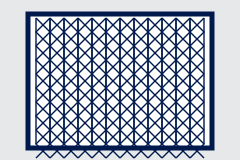
A grille behind the glass starts from £1,380 inc VAT (£1,150 plus VAT) and has no box at all.
How much room does an internal shutter need?
It needs clear height above the opening for the box and clear depth behind the glass for the curtain to run. The box size depends on the height of the shutter and the curtain, so it is confirmed at survey.
Before you book, check what sits in that zone. Suspended ceilings, downlights, sprinkler pipes, alarm sensors, door closers and pelmets are the usual problems. Inward-opening doors are another, because the curtain has to close on the shop side of the door or the door has to be secured separately.
The measuring guide shows what to record.
What does an external shutter need from the frontage?
Sound fixing points for the guides and box come first, along with enough depth or height to house the curtain. Brick piers and steel frames usually give good fixings. Old timber fascias and thin cladding often do not, and that can add work.
Look at what is already on the front: signs, lights, canopy brackets, alarm boxes and hanging signs. Any of these can clash with the box. If you want the box hidden, it goes behind the fascia, which means opening up the fascia, and the survey will show whether there is room.
The street counts too. A box or guide that projects over a footway can attract questions, and a bottom rail at pavement level takes knocks from bins, bikes and street cleaning. Point these out at survey so that the fixings and position suit them.
Which position suits which premises?
Let the glass decide first. If a broken pane would be expensive or would stop you trading, that points outside.
| Situation | Lean towards | Why |
|---|---|---|
| Large single pane on a busy road | External | Keeps the glass behind the steel |
| Listed building or conservation area | Internal, after asking the council | The frontage stays as it is |
| Deep fascia with room behind it | External, box built in | Hides the box |
| Low or crowded ceiling inside | External | No box indoors |
| Display kept close to the glass | External | An internal curtain needs a clear zone |
| Small side window | Internal grille | Short span, no change to the outside |
Changing position later means a new box, new guides and new fixings, so it is worth getting right at the start. Ask for both to be priced at survey if you are unsure.
Which position is simpler with the council?
Internal may raise fewer questions, but do not assume it raises none. External shutters are the ones council guides concentrate on, and solid external shutters most of all.
A listed building changes things even for internal work. Our planning guide sets out what Midlands councils have published, with dates, and what to ask your own council. Check the lease too, because a landlord may have a view on either position.
Which is easier to live with day to day?
Internal is easier on the shutter, and external is easier on the shop. An internal curtain stays clean, but you have to keep the zone behind the glass clear and reach the window for cleaning.
An external shutter leaves the inside alone. It does need its guides kept free of grit, and the key switch or lock is outside in the weather unless it is fitted inside. On either, a shutter that gets used twice a day needs a suitable system of maintenance.
Common questions
Can I have both an internal grille and an external shutter?
You can, but ask what the second layer adds for the cost. Tell us what you are trying to protect and we will price the options side by side.
Does an internal shutter need an external key switch?
Not if you can leave by another door. If the shutter is on your only exit, the key switch and door arrangement need thinking through at survey.
Can an external box be painted to match?
A powder-coated colour is available as its own line on the quotation. Ask for the colour to be stated there.
Do you fit internal shutters in shopping centres?
Ask the centre management first, because a centre usually has its own rules on shutters. Then send us the details and we will look at the opening.